
This article contains affiliate links. We may earn a commission if you buy through our links, at no extra cost to you.
The best standing desk under $300 is chosen on frame quality and desktop construction, not on the feature list. Under that price every desk offers memory presets, anti-collision and a motor that runs below 50dB. What separates them is how steady the surface feels at standing height.
The budget tier has closed most of the gap with premium desks. A $150 frame today lifts 154 lbs and travels nearly 18 inches, which is what a $600 desk did a few years ago.
After comparing height ranges, load ratings, motor specs, desktop construction and long-term owner feedback across more than 20 models, four stand out. One wins on desktop rigidity, two on size and storage, and one on price per inch of surface.
Quick Answer
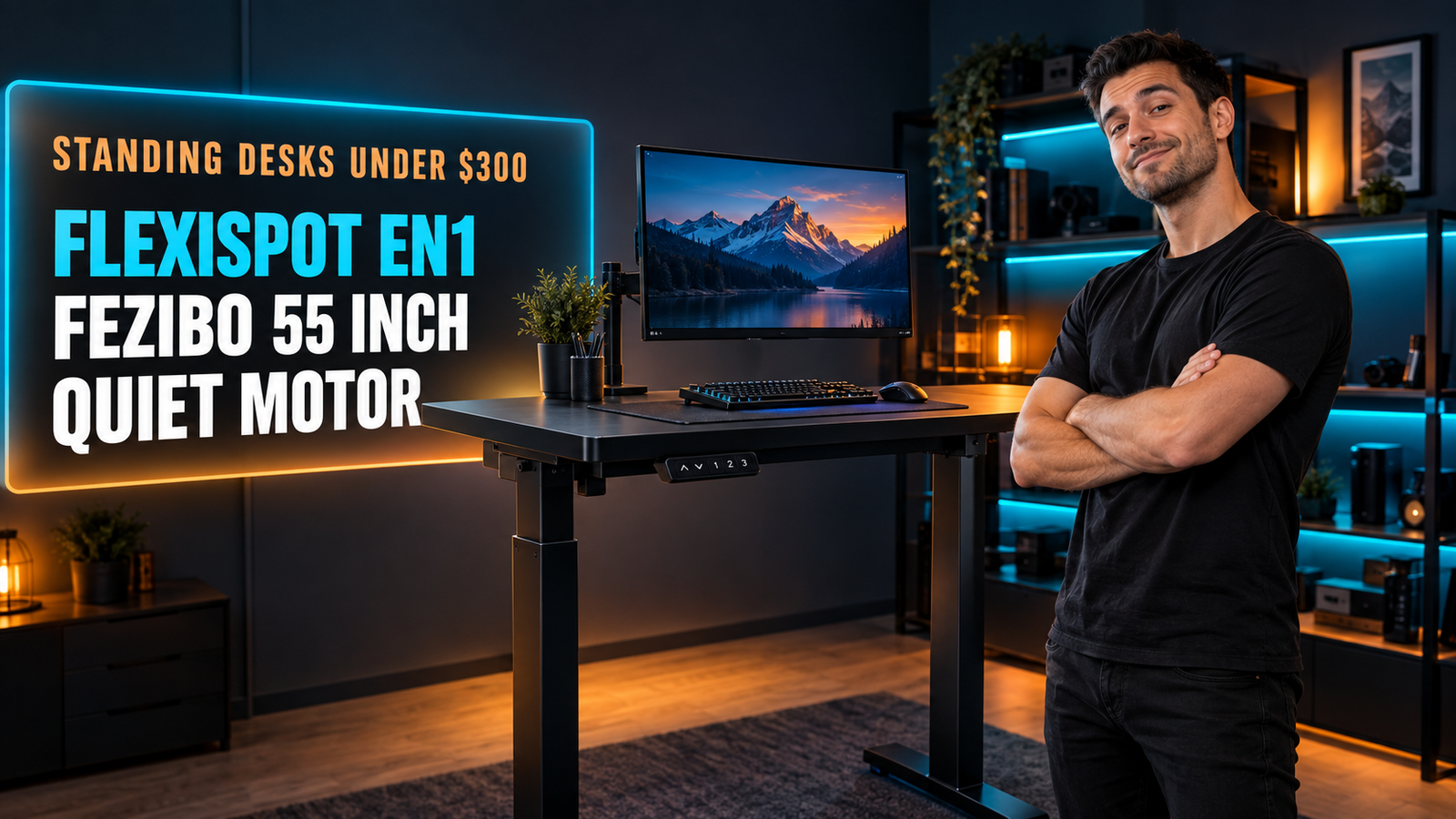
The FLEXISPOT EN1 is the best standing desk under $300 for most people, with a one-piece desktop, 154 lbs of capacity and a 28.9 to 46.5-inch range. For a wider surface, the FEZIBO 55″ with Keyboard Tray adds 176 lbs and lockable casters, the FEZIBO 55″ with Drawers and LEDs brings storage, and the FEZIBO 55″ Splice Board runs quietest at under 45dB.
What Do You Actually Get Under $300?
Under $300 you get a powered frame, memory presets, anti-collision and a wood-composite desktop. What you don’t get is a three-stage frame, a solid hardwood top or a commercial warranty.
The cheapest desk here has the most rigid desktop. The FLEXISPOT EN1 uses a single-piece FSC-certified board at 48 x 24 inches, while the wider FEZIBO models use splice boards, two panels joined across the middle. A seam sits exactly where a monitor arm clamp usually wants to go.
Frame stages are the other invisible spec. Nearly everything at this price is two-stage, meaning two tube sections per leg, which caps the height range and adds a little sway at full extension compared with three-stage frames on desks costing twice as much.
If your monitor sits on an arm, check where the seam falls before buying a splice-board desk. Our guide to the best monitor arm for desk covers clamp requirements, and a 0.6-inch composite top with a seam is the surface those clamps have to grip.
How High Does the Desk Need to Go?
The bottom of the height range matters more than the top for most buyers. Standard fixed desks sit at 29 to 30 inches, and anyone shorter than average has spent years working at a desk that was too tall.
The FEZIBO 55″ with Drawers drops to 27.16 inches, nearly two inches below a standard desk, while the FLEXISPOT EN1 stops at 28.9 inches. If you’re under 5’4″, that difference decides whether the sitting position works at all.
At the top end, the four desks here land between 45.5 and 46.5 inches, which covers standing work for most people up to roughly 6’2″. Taller than that and you’re looking at a different price bracket.
Being able to change position through the day is the whole point of the purchase, so check both numbers against your own measurements rather than trusting the marketing. Measure from the floor to your elbow while standing with your forearms level, then add the desktop thickness. If the result sits above the desk’s maximum, the desk is wrong for you no matter how good the reviews are.
Does Weight Capacity Actually Matter?
Weight capacity is rarely the limiting factor on a standing desk. The models here carry 154 to 176 lbs, and a heavy setup with two 27-inch monitors, a tower, a keyboard and a laptop rarely passes 80 lbs.
The number you can’t see on the spec sheet is the one that matters: sway at full height. A 55-inch desktop on a two-stage frame moves more at 46 inches than a 48-inch top on the same frame, because the wider the surface, the longer the lever acting on the legs.
Capacity still matters in one situation. If your monitors sit on an arm clamped to the edge, the load concentrates at one point rather than spreading across the top, which is harder on the frame than the total weight suggests.
If you type hard or your desk sits against a wall you can brace it on, sway becomes a non-issue. If it floats in the middle of a room with three monitors on it, the narrower FLEXISPOT EN1 is the steadier choice, even though it lists the lowest capacity here at 154 lbs.
How Much Do Motor Noise and Speed Matter?
Motor noise is a real consideration in a shared space, and the spread is small but noticeable. Three of these desks list under 50dB while the FEZIBO 55″ Splice Board lists under 45dB, roughly the difference between a fridge hum and a quiet room.
Dual motors don’t lift more than single motors at this price. They lift faster and more evenly, which is why the FEZIBO models with two motors move at a higher speed than the EN1’s 0.6 inches per second.
That speed difference is more meaningful than it looks. Rising 18 inches at 0.6 inches per second takes about 30 seconds; at 1 inch per second it takes 18. A desk that takes half a minute to move is a desk you adjust less often.
Cycle ratings tell you about longevity. FEZIBO rates the splice-board model’s motor at 50,000 lift cycles, which at ten adjustments a day works out to well over a decade. We’d take the quieter, faster motor over an extra 20 lbs of capacity every time.
Which Extras Are Worth Paying For?
The cheapest-sounding extra is the most useful one. Lockable casters, included on the FEZIBO 55″ with Keyboard Tray, turn a 60-pound desk into something you can roll away from the wall to clean behind or reposition entirely.
LED strips are decoration. The FEZIBO 55″ with Drawers includes them alongside a monitor shelf and two drawers, and the drawers are the part that earns its keep in a room with no filing space.
Keyboard trays are the one extra to think twice about. A slide-out tray lowers your typing surface by a couple of inches, which effectively changes the desk’s usable height range, and it eats knee clearance under a 24-inch-deep top.
Cable management is the extra nobody includes and everybody needs. A desk that travels 18 inches vertically pulls every cable with it, and a power strip mounted on the frame rather than the wall is the fix; the solutions in our cable management guide apply directly here.
Best Standing Desks Under $300: Comparison Table
| Product | Price | Best For | Rating |
|---|---|---|---|
| FLEXISPOT EN1 | ~$140 | Best overall | 9/10 |
| FEZIBO 55″ Keyboard Tray | ~$210 | Mobility and space | 8.5/10 |
| FEZIBO 55″ Drawers + LED | ~$260 | Storage | 8/10 |
| FEZIBO 55″ Splice Board | ~$180 | Quietest motor | 8.5/10 |
Detailed Reviews
FLEXISPOT EN1 — Best Overall
A one-piece desktop is the specification that puts this one first. FlexiSpot builds the EN1’s 48 x 24-inch top from a single FSC-certified board rather than two panels joined in the middle, so there’s no seam under a monitor arm clamp or a mouse pad. The frame lifts 154 lbs across a range of 28.9 to 46.5 inches at 0.6 inches per second, under 50dB, with four memory presets on the controller.
If your desk sits in the open with monitors on an arm, the seamless top and the narrower 48-inch width make this the steadiest option here at standing height.
Its single motor is the slowest in this guide, taking roughly 30 seconds for the full travel. At 48 inches wide it’s also the smallest surface, which rules out three monitors, and 154 lbs is the lowest capacity listed here. For a single-monitor or dual-monitor desk, we’d buy it over anything wider at this price.
Best for: Desks in the open where rigidity matters more than surface area.
Real-world detail: The one-piece top has no central seam, unlike every splice-board desk in this guide.
Pros: One-piece FSC desktop, 4 memory presets, under 50dB, 28.9-46.5 inch range, lowest price here.
Cons: Slowest travel at 0.6 in/s, smallest surface at 48 inches, 154 lbs capacity.
FEZIBO 55″ with Keyboard Tray — Best for Mobility
Lockable casters change how a standing desk fits a room. This FEZIBO pairs a dual-motor frame with 360-degree swivel casters, so a 55 x 24-inch desk can be rolled away from the wall and locked back in place, and it adds a slide-out keyboard tray, a monitor shelf with drawers and 176 lbs of capacity across a 27.36 to 46.04-inch range.
If you rent, rearrange often, or need to reach a wall socket behind the desk, wheels solve a problem no amount of frame quality does. The dual motors also move the top faster than the EN1’s single motor.
The keyboard tray is a mixed blessing: it frees desktop space but reduces knee clearance and shifts your typing height down, which matters on a 24-inch-deep top. The splice-board desktop has a central seam, and casters always add a little movement compared with feet planted on the floor. For a desk that needs to move, it’s the pick.
Best for: Rooms that get rearranged, or desks that need to roll away from a wall.
Real-world detail: The 360-degree casters lock, so the desk stays put once positioned but moves without lifting.
Pros: Lockable casters, dual motors, 176 lbs capacity, keyboard tray and drawers, 55-inch top.
Cons: Splice-board seam, keyboard tray cuts knee clearance, casters add slight sway.
FEZIBO 55″ with Drawers and LEDs — Best for Storage
Two drawers and a monitor shelf make this the desk for rooms with no other storage. The black walnut finish covers 55 x 24 inches, the frame handles 176 lbs between 27.16 and 46.06 inches, and three memory presets plus anti-collision are standard, with the desk reversing 2cm if it meets an obstacle. Surrounding LED strips are included.
If your home office is a corner of a bedroom with no filing cabinet, the drawers hold what would otherwise live on the desktop. The 27.16-inch minimum is also the lowest here, which suits shorter users better than the EN1’s 28.9 inches.
Its LEDs are pure decoration and add cost you may not want; a $15 strip does the same job wherever you prefer. It’s the most expensive desk in this guide, the drawers reduce knee clearance on one side, and the splice board carries the usual seam. Buy it for the storage, not the lighting.
Best for: Small rooms where the desk has to replace a filing cabinet.
Real-world detail: It drops to 27.16 inches, nearly two inches lower than a standard fixed desk.
Pros: Two drawers and monitor shelf, lowest minimum height here, 176 lbs, anti-collision, 55-inch top.
Cons: Most expensive here, LEDs add cost without function, splice-board seam.
FEZIBO 55″ Splice Board — Quietest Motor
Under 45dB is the number that separates this one from the rest of the category. FEZIBO rates the motor at 50,000 lift cycles and moves the 55.1 x 23.6-inch top between 28.3 and 46.5 inches, with three memory presets, a reinforced steel frame and 176 lbs of capacity. The desktop is FSC-certified wood in several colors and sizes.
If your desk shares a room with a sleeping partner or sits in an open-plan office, 45dB against 50dB is the difference between a noticeable rise and one nobody comments on. The 50,000-cycle rating also covers a decade of daily adjustment.
The 28.3-inch minimum is higher than the drawer model’s 27.16 inches, so shorter users lose the lowest sitting position. It’s a plain desk with no tray, drawers or casters, and the splice board has the usual central seam. For the money, it’s the best frame-and-motor combination here.
Best for: Shared rooms where motor noise is the deciding factor.
Real-world detail: Its motor is rated for 50,000 lift cycles, roughly a decade at ten adjustments a day.
Pros: Under 45dB, 50,000-cycle motor rating, 176 lbs, 55-inch top, multiple sizes and colors.
Cons: No storage or tray, 28.3-inch minimum height, splice-board seam.
What to Look for When Choosing a Standing Desk Under $300
1. Check the minimum height, not just the maximum. Standard desks sit at 29 to 30 inches. If you’re shorter than average, a desk that drops to 27 inches changes the sitting position more than the standing one.
2. Prefer a one-piece desktop if you use a monitor arm. Splice boards have a central seam exactly where clamps and mounts tend to sit. A single-piece top is also more rigid across its width.
3. Read the motor specs, not the capacity. Everything here lifts far more than a desk setup weighs. Travel speed in inches per second, noise in dB and cycle ratings tell you more about daily use.
4. Match width to stability, not to ambition. A 55-inch top sways more at full height than a 48-inch one on the same frame. If the desk stands in the open with three monitors, narrower is steadier.
5. Plan for cables before assembly. A desk that travels 18 inches pulls every cable with it. Mount the power strip on the frame rather than the wall, and leave slack at standing height.
FAQ
How much should you spend on a standing desk?
A budget of $150 to $300 buys a two-stage electric frame with memory presets, anti-collision and 150 to 180 lbs of capacity, which covers most home setups. Above $500 you’re paying for three-stage frames, solid hardwood tops and longer commercial warranties. Under $150, expect manual crank models or very limited height ranges.
Are cheap standing desks stable?
Budget standing desks are stable at sitting height and show some sway at full standing extension, which is normal for two-stage frames. Narrower tops sway less than wide ones, and pushing the desk against a wall removes most of the movement. Weight capacity ratings are not a reliable guide to stability.
What height should a standing desk be?
Set a standing desk so your forearms are roughly level when your hands are on the keyboard, which for most adults falls between 40 and 46 inches. Measure from the floor to your elbow while standing to find your number. Desks under $300 typically top out around 46 inches.
Is a one-piece desktop better than a splice board?
A one-piece desktop is more rigid across its width and has no central seam, which matters if you clamp a monitor arm or use a large mouse pad. Splice boards are cheaper to ship and allow wider surfaces at the same price. For desks up to 48 inches, one piece is the better buy.
Our Final Verdict
For most home offices, the FLEXISPOT EN1 is the standing desk to buy under $300: a one-piece 48 x 24-inch FSC desktop, 154 lbs of capacity, four memory presets and a 28.9 to 46.5-inch range at the lowest price here.
If you need a wider surface, the FEZIBO 55″ with Keyboard Tray adds lockable casters and dual motors. The FEZIBO 55″ with Drawers and LEDs replaces a filing cabinet in a small room, and the FEZIBO 55″ Splice Board runs under 45dB with a motor rated for 50,000 cycles.