As an Amazon Associate we earn from qualifying purchases made through links on this page.
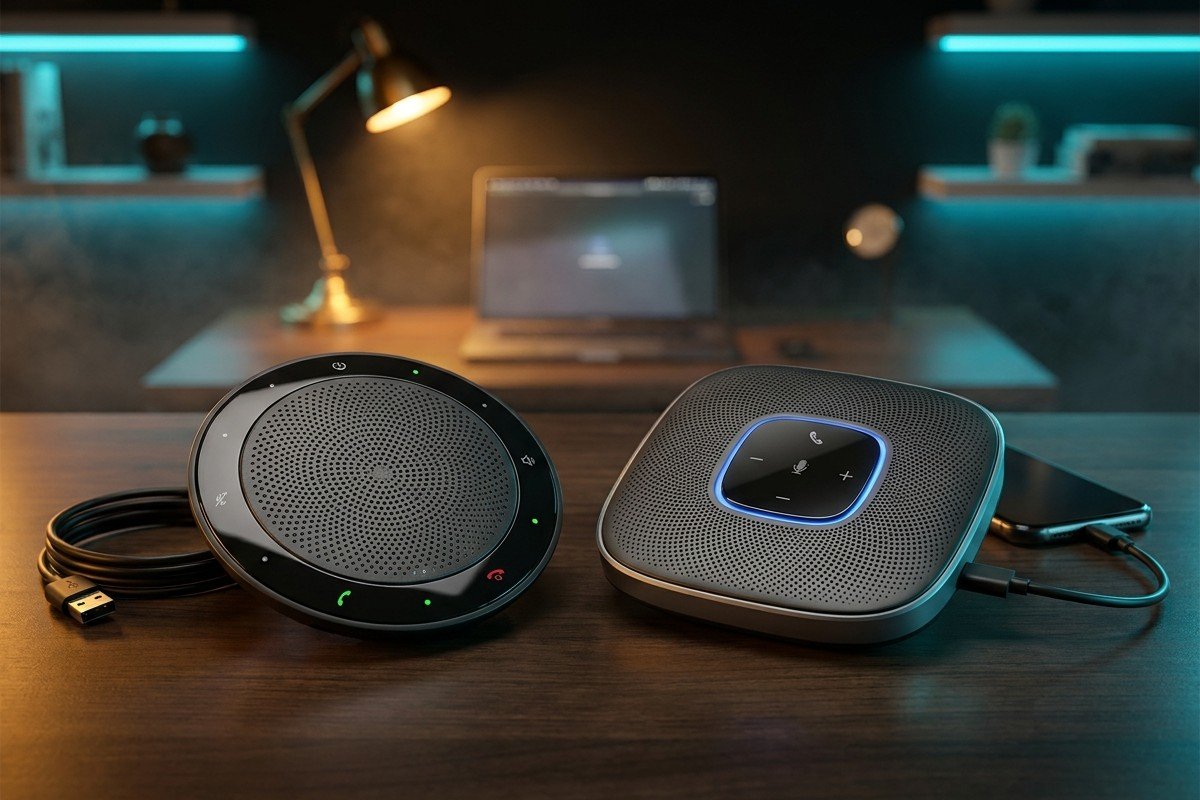
The person who hears your speakerphone is never you. It is everyone else on the call, and that is where the Jabra Speak 510 vs Anker PowerConf decision is won or lost. Both are hockey-puck speakerphones for a laptop or a phone, both connect by cable or Bluetooth, and they sit about $10 apart.
On paper the Anker should walk it: six microphones against one, 24 hours of calls against 15, and it doubles as a phone charger. The owner reviews tell a different story, and it is about the one thing a speakerphone exists to do.
We compared the manufacturers’ specifications, the two Amazon listings and the themes that repeat across thousands of owner reviews; we did not test either unit. Both also appear in our best speakerphone for home office guide, and this page puts the two head to head.
Steady pickup settles this one. Anker says the PowerConf’s six-microphone array automatically balances your voice for volume and distance, yet the most mentioned theme in its Amazon review summary is inconsistent call audio, with 539 mentions of volume that rises and falls. The Jabra’s single omnidirectional microphone carries no such theme; its reviews lead with sound quality, mentioned 992 times.
Quick Answer
The Jabra Speak 510 is the one to buy for calls from a home office: it is lighter, its owners praise how it sounds, and nothing in its reviews suggests your voice drifts. The Anker PowerConf is the better pick if you work away from a socket all day, because it runs about 24 hours on a charge and can top up your phone.
Six Microphones Did Not Buy the Anker a Steadier Voice
More microphones is the spec that sells the Anker PowerConf, and it is the wrong one to buy on if you sit alone at a desk. A ring of six mics is built to hear voices from every side of a table. One person a foot away does not need that reach.
Anker says the PowerConf balances your voice automatically to make up for differences in volume and distance. Owners keep describing the opposite of what they want: the review summary counts 539 mentions of call audio whose volume swings up and down, even while background noise is handled well. That is the complaint that matters most, because you never hear it yourself. Your colleagues do.
The Jabra Speak 510 uses a single omnidirectional microphone, so it listens equally in every direction from the middle of the puck. Its review summary is led by sound quality, with 992 mentions, and call quality and home office use both show up as strengths. If your calls are you plus a laptop, a mic that stays put beats a mic that keeps adjusting. If you would rather your voice never leave a boom arm, our headset for remote work guide is the other route. The Jabra wins this one.
24 Hours Against 15: The Anker Wins Every Day Away From a Socket
Battery is where the Anker earns its place. Anker rates the PowerConf for up to 24 hours of calls on one charge; Jabra rates the Speak 510 for up to 15 hours of talk time. Fifteen hours is still about two full workdays of back-to-back meetings, so at a desk with a USB port nearby the gap rarely shows.
It shows on the road. The PowerConf has a USB output that charges other devices, which Anker calls PowerIQ, and its listing pitches exactly that: charging your phone while you are on the conference call. On a travel day the speakerphone becomes the battery pack you would otherwise carry separately.
Jabra quotes about two hours to recharge the Speak 510. Anker does not publish a charging time for the PowerConf, so that part cannot be compared. If you take calls from hotels, cars or client offices, the Anker wins this one, and it is not close.
Both Connect by Cable or Bluetooth, and Only One Is Picky About Apps
Plugging in is the easy part on both. The Speak 510 has its USB cable built in, wrapped into a groove in the body, so there is no cable to lose in a drawer. The PowerConf uses a detachable USB-C cable, and Anker says it needs no drivers. If your laptop is already short on ports, a USB hub for home office solves that for either one.
Software is where they part. Connecting varies by app is the third theme in the PowerConf’s review summary, with 221 mentions: it pairs easily, but it does not behave the same in every meeting program. The Jabra’s summary lists connectivity and compatibility as strengths, with 417 and 201 mentions, and owners name Microsoft Teams and Skype for Business among the systems it works with.
Both listings carry Zoom certification, so neither should fight you on Zoom, and either pairs well with a camera from our webcam for Zoom calls guide. A speakerphone that misbehaves in Teams on a Monday morning is worse than one with fewer features. The Jabra wins on connection, narrowly.
195 Grams in a Pouch Against 340 Grams in a Case
The Jabra is the one that disappears into a bag. Jabra lists the Speak 510 at 195 g; the PowerConf listing gives 12 ounces, about 340 g, about 145 g more for the Anker. You feel that difference in a backpack long before you feel it on a desk.
The Jabra comes with a zippered soft pouch, and portability shows up 173 times in its review summary, usually as owners slipping it into a backpack or a purse. The Anker’s listing includes a travel case, and at about 4.9 by 4.8 inches and just over an inch thick it has roughly the footprint of a coaster. If the speakerphone lives on your desk, weight hardly matters; if you need studio-grade voice there instead, a dedicated microphone for video calls is the next step up. If it lives in your bag, the Jabra wins.
Seven Lines, and the Price Gap Is Only $10
Two Speakerphones, and Who Should Skip Each
Jabra Speak 510 — The Steadier Voice
You give up nine hours of battery and the phone-charging trick by choosing the Jabra Speak 510, and for a home office that is a good trade. At about $120 it is the slightly dearer of the two. Jabra rates it for up to 15 hours of talk time at 195 g, with a single omnidirectional microphone and a USB cable built into the body, so the whole thing packs into its pouch in one piece.
If you take most of your calls alone at one desk, on a laptop, this is the puck that keeps your voice where you left it. Its Amazon listing shows more than 5,900 ratings at 4.7 out of 5, and sound quality is the theme owners mention most. It works over Bluetooth with a phone or through its cable with a computer, and the listing names Zoom and Google Meet certification.
Where it falls short is age. Jabra lists Bluetooth 3.0, an old standard, and only the Speak 510+ version comes with Jabra’s Link 380 wireless adapter for a computer; the standard model relies on your computer’s own Bluetooth or on its cable. The listing we link is sold by a third-party seller and shipped by Amazon, so check the seller name before you pay.
Skip it if you work away from a socket all day, or if you want one gadget that also charges your phone.
Anker PowerConf — The Road Pick
If your meetings happen in a hotel room, a car or a client’s spare office, the Anker PowerConf is built for your week. Anker rates it for up to 24 hours of calls on one charge, it has a USB output that tops up your phone, and at about $110 from Anker’s own store on Amazon it costs about $10 less than the Jabra.
Anker says the six microphones pick up voices from all directions, which is the feature you want when several people share the table rather than one person at a desk. It connects with a detachable USB-C cable or Bluetooth, the listing includes a travel case, and it carries Zoom certification. The listing shows more than 5,900 ratings at 4.4 out of 5, and loudness is one of its most praised traits, with 416 mentions.
The weakness is the one reviewers keep repeating. Inconsistent call audio leads its review summary with 539 mentions: background noise is handled well, but the volume of your voice can swing. Connecting varies by app follows with 221. At about 340 g it is also the heavier of the two by a wide margin.
Skip it if you take calls alone at one desk and care more about how you sound than about how long the battery lasts.
The Call
The Jabra Speak 510 is our pick for a home office, because the job of a speakerphone is to make you sound the same at minute fifty as at minute one. Buy the Anker only if a 24-hour battery and a built-in phone charger matter more to you than that.