
This article contains affiliate links. We may earn a commission if you buy through our links, at no extra cost to you.
You’re comparing two monitors with nearly identical specs — same resolution, same refresh rate, same price — and one says “IPS” while the other says “VA.” That single letter difference changes everything about how the screen looks on your desk. The IPS vs VA monitor debate comes down to a fundamental tradeoff: IPS panels win on color and viewing angles, VA panels win on contrast and deep blacks.
After researching panel technology and comparing how each performs across real work and gaming scenarios, here’s what actually matters when you choose. This guide breaks down the real differences — not the spec-sheet marketing — explains which panel suits which use case, and recommends a verified monitor for each. If you’re shopping for a specific use, our guide to the best monitor for eye strain covers panel comfort in depth.
Quick Answer
For most home office and creative work, IPS is the better choice — its accurate colors and wide viewing angles matter more for daily desktop use. VA is better if you want deep blacks for movies and immersive single-player gaming, or a curved ultrawide. Neither is universally “better”; it depends on whether you prioritize color accuracy (IPS) or contrast (VA).
IPS vs VA: The Core Difference in One Minute
Both IPS and VA are types of LCD panel, and both are backlit the same way. What differs is how the liquid crystals align and let light through — and that single engineering choice cascades into every visible difference.
IPS (In-Plane Switching) crystals shift horizontally. This produces excellent color accuracy and viewing angles so wide the image barely shifts even when you look from the side. The tradeoff: IPS panels struggle to fully block their backlight, so blacks look more like dark gray, and you may see “IPS glow” in corners.
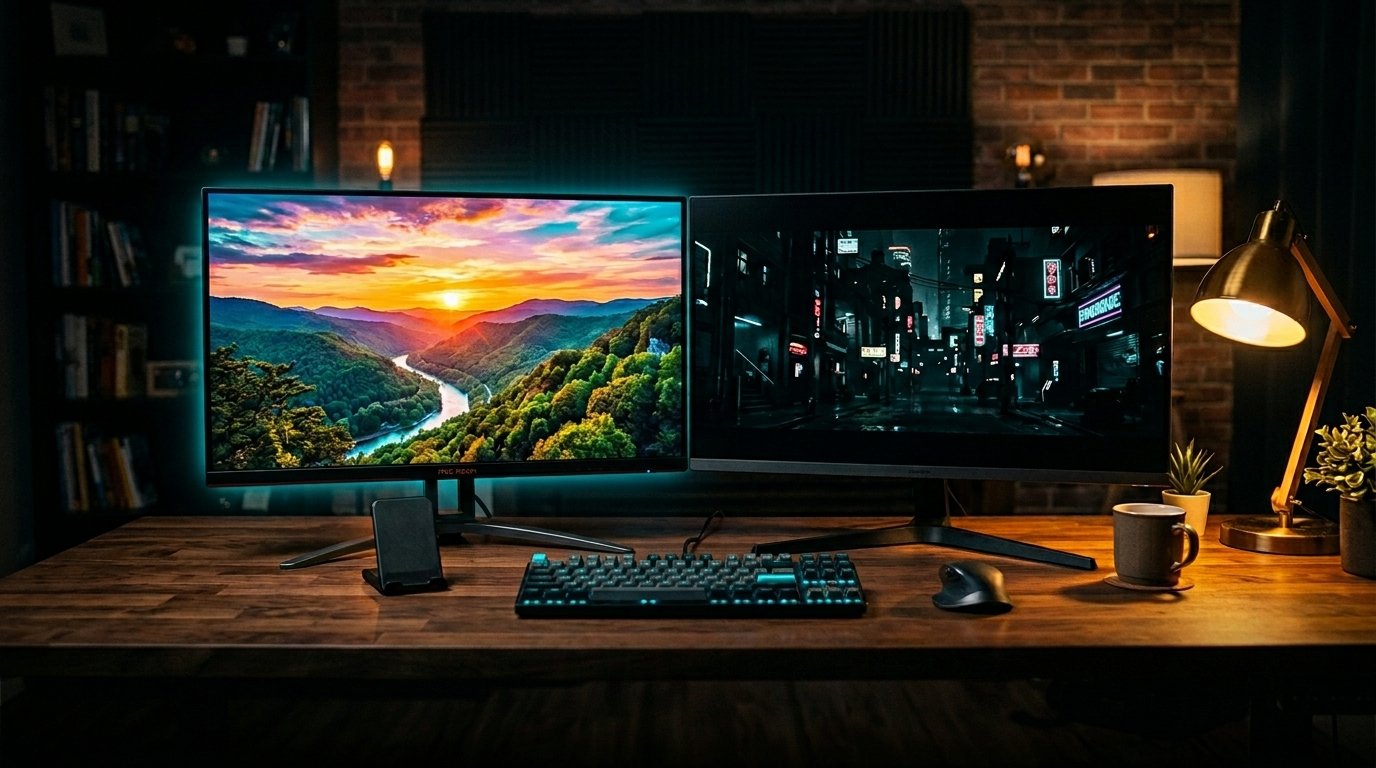
VA (Vertical Alignment) crystals shift vertically, blocking light far more effectively. That gives VA panels much deeper blacks and higher contrast — typically 3000:1 versus IPS’s 1000:1. The tradeoff: narrower viewing angles and slower pixel response, which can cause smearing in fast dark scenes.
The honest truth is that for a single person sitting directly in front of a screen for work, the contrast advantage of VA is more noticeable day-to-day than most reviews admit — but the moment color accuracy matters, IPS pulls ahead decisively.
Color and Viewing Angles: IPS Wins
If your work involves color — photo editing, design, video, or even just wanting accurate-looking photos — IPS is the clear winner. IPS panels reproduce color more accurately out of the box and hold that accuracy across the entire screen and from any angle.
VA panels have improved, and a good VA covers a wide color gamut. But they suffer from a specific weakness: color and brightness shift when you move off-center. On a large VA monitor, the edges can look slightly darker than the center even when you’re sitting directly in front — a phenomenon called “VA gamma shift.”
A concrete scenario: a freelance designer reviewing a client’s brand colors needs the red on the left edge of the screen to match the red on the right. On IPS, it does. On a large VA panel, the corners may drift just enough to cause second-guessing.
What most reviews won’t tell you is that for multi-monitor setups, IPS is almost always the right call — because you view side monitors at an angle, and that’s exactly where VA falls apart. For dual-screen productivity, see our guide to the best dual monitor setup for home office.
Contrast and Black Levels: VA Wins
Here’s where VA earns its place. A VA panel’s contrast ratio is typically 3000:1 — three times higher than a typical IPS panel’s 1000:1. In practice, that means blacks that look genuinely black instead of dark gray.
This matters more than spec sheets suggest. In a dim room watching a movie, an IPS panel’s black bars glow faintly gray, while a VA panel’s disappear into the darkness of the room. For anyone who watches films, plays atmospheric single-player games, or works in a dark room, that contrast is immediately visible.
The counterintuitive part: more expensive doesn’t always mean better blacks. A $250 VA monitor will produce deeper blacks than a $600 IPS monitor, because this is a fundamental panel-technology difference, not a price difference. You can’t buy your way out of IPS’s contrast limitation without jumping to OLED or mini-LED at much higher prices.
A real scenario: someone setting up a home theater PC or a gaming setup in a basement room with controlled lighting will be far happier with VA’s inky blacks than with IPS’s grayish ones, regardless of which costs more.
Response Time and Gaming: It Depends
This is where the answer gets nuanced. On paper, IPS panels generally have faster pixel response times, which means less motion blur in fast games. Modern IPS gaming monitors hit 1ms GtG and are the default choice for competitive FPS players.
VA panels are typically slower to transition, especially from dark to bright pixels — which causes “black smearing,” a faint trail behind fast-moving objects in dark scenes. We found this to be the single most common complaint about VA gaming monitors, and it’s real on cheaper models.
But VA isn’t out of the gaming conversation. For immersive single-player games — open-world RPGs, atmospheric horror, story-driven titles — VA’s superior contrast makes dark scenes look dramatically better, and the smearing rarely matters when you’re not twitch-aiming. Many curved ultrawide gaming monitors use VA panels precisely for this immersive quality.
The rule of thumb: competitive/fast-paced gaming leans IPS; immersive/cinematic gaming leans VA. For the broader picture, our guide to the best ultrawide monitor for productivity covers both panel types.
Recommended Monitors: One IPS, One VA
If this comparison helped you decide, here are two verified picks — one of each panel type — that represent strong value in 2026.
Comparison Table
| Product | Price | Panel | Best For | Rating |
|---|---|---|---|---|
| Dell UltraSharp U2723QE | ~$580 | IPS | Color-accurate work | 9.5/10 |
| Samsung Odyssey G85SB | ~$1000 | VA (OLED-class contrast) | Immersive gaming | 9/10 |
Dell UltraSharp U2723QE — Best IPS for Work (~$580)
The Dell UltraSharp U2723QE is the IPS pick for anyone whose work depends on color. It uses Dell’s IPS Black technology — an enhanced IPS panel that roughly doubles standard IPS contrast to around 2000:1, narrowing VA’s biggest advantage while keeping IPS’s color and viewing-angle strengths. It’s a 27-inch 4K panel with 98% DCI-P3 coverage and factory calibration.
Best for: Designers, photographers, developers, and home office users who want accurate color and wide viewing angles.
Real-world detail: The IPS Black tech is the key differentiator — it’s the rare IPS monitor where blacks look genuinely deep, addressing the one area where IPS traditionally loses to VA, which makes it a safe pick even for someone torn between the two.
Pros: IPS Black higher contrast, 4K, 98% DCI-P3, factory calibrated, excellent build, USB-C hub.
Cons: Premium price, not a high-refresh gaming panel, overkill for casual use.
Samsung Odyssey G85SB — Best VA-Class for Gaming (~$1000)
The Samsung Odyssey G85SB represents where VA-style contrast goes premium — a curved ultrawide built for immersive gaming with deep blacks and rich contrast that IPS panels can’t match. It delivers the cinematic, inky-black experience that makes VA-style panels the favorite for single-player and atmospheric games.
Best for: Gamers who prioritize immersion, contrast, and a curved ultrawide experience over competitive twitch response.
Real-world detail: The curved ultrawide format plus high contrast is the combination that makes open-world games feel enveloping — the deep blacks mean night scenes and shadow detail look dramatically better than on any standard IPS panel.
Pros: Outstanding contrast and deep blacks, immersive curved ultrawide, high refresh, premium build.
Cons: Premium price, curve isn’t ideal for precise design work, large desk footprint.
What to Look for When Choosing Between IPS and VA
1. Your primary use case Color work (design, photo, video) → IPS. Movies and immersive gaming in a dark room → VA. General mixed use → IPS is the safer default, since its weaknesses (contrast) bother fewer people than VA’s (viewing angles, smearing).
2. Your room’s lighting A bright room masks VA’s contrast advantage — you won’t notice the deep blacks under daylight. A dark or controlled-lighting room makes VA shine and makes IPS glow look worse. Match the panel to where the monitor actually lives.
3. Single vs multi-monitor Multiple monitors mean viewing side screens at an angle — IPS handles this far better. For a single centered monitor, VA’s angle weakness matters much less.
4. The type of gaming you do Competitive FPS where every millisecond counts → IPS for faster response. Story-driven, atmospheric, or curved-ultrawide gaming → VA for contrast and immersion.
5. Don’t ignore newer hybrids Technologies like Dell’s IPS Black narrow the gap by boosting IPS contrast. If you want IPS color with better-than-usual blacks, these hybrids are worth the premium and reduce the need to compromise.
FAQ
Is IPS or VA better for office work?
IPS is generally better for office work. Its accurate colors, wide viewing angles, and consistent image across the whole screen suit spreadsheets, documents, design, and video calls. VA’s main advantage — deep blacks — matters less for productivity, while its weaker viewing angles can be a mild annoyance on larger screens or multi-monitor setups.
Is VA good for gaming?
VA is good for immersive, single-player, and atmospheric gaming, where its high contrast and deep blacks make dark scenes look dramatically better. It’s less ideal for fast competitive games, since VA panels can show “black smearing” — a faint trail behind fast-moving objects in dark scenes. For competitive FPS, IPS’s faster response is the safer choice.
Why do IPS monitors have worse blacks?
IPS panels can’t fully block their backlight because of how the liquid crystals align, so light leaks through and blacks appear dark gray rather than true black. This also causes “IPS glow,” a faint brightness in the corners visible on dark screens. VA panels block light more effectively, giving them roughly 3x higher contrast.
Should I pay more for IPS or VA?
Neither is inherently more expensive — both span budget to premium. Choose based on use case, not price, since this is a technology tradeoff, not a quality ladder. A $250 VA will have deeper blacks than a $600 IPS, while that IPS will have better color accuracy and angles. Match the panel to what you actually do.
Our Final Verdict
So, IPS vs VA monitor — which is better in 2026? For most people, IPS wins as the safer, more versatile choice — accurate color, wide viewing angles, and consistency that suit work, mixed use, and competitive gaming. The Dell UltraSharp U2723QE with IPS Black is the standout. Choose VA if deep blacks and immersive or curved-ultrawide gaming are your priority — the Samsung Odyssey G85SB delivers that cinematic contrast.
Match the panel to your room and your work, not to the price tag. Check current pricing on Amazon and pick the panel that fits how you actually use your screen.